Key Sustainability Topics
The Investis Group ranks among the largest real estate companies in Switzerland, with a clear emphasis on residential properties. It primarily offers mid-range apartments in the Lake Geneva region. For more details on the business model, please refer to the Business model chapter of this Annual Report.
The divestment of the Services segment, finalised in mid-2024, represents a strategic decision to streamline operations and concentrate on the core property business. This sale strengthens liquidity, reduces operational complexity and enables the Group to reinvest in core real estate assets.
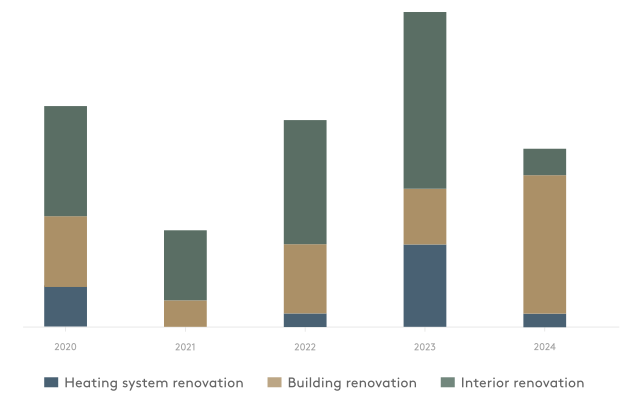
The Group entered a new phase of its sustainability and growth strategy in 2024 with the initiation of major renovations across its property portfolio. Building on its commitment to environmental responsibility, Investis’ renovations are aimed at reducing CO2 emissions and improving tenant wellbeing. They also represent Investis’ focus on enhancing the energy efficiency of its portfolio.
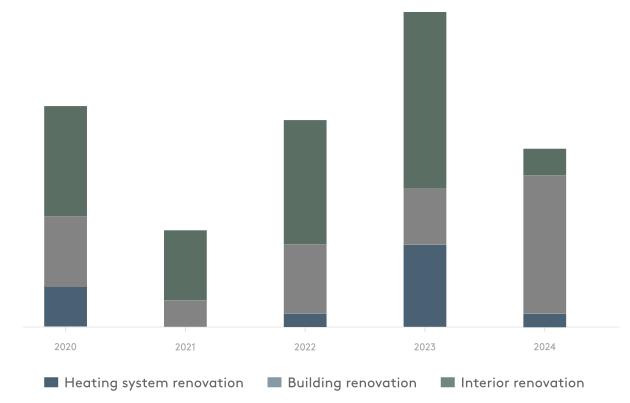
The following table presents the number of buildings that underwent renovations, categorised by interior refurbishments, exterior upgrades and heating system improvements.
Investis reaffirms its commitment to ethical practices and human rights and states that it does not support child labour, corruption or the trade in rare earth minerals. Investis is only active in Switzerland and has no activities abroad. The Group has no supply chains in high-risk countries. Therefore these issues are not relevant to the Group’s operations. The Company emphasises on transparency, integrity and accountability. Through its materiality assessment, Investis highlights its commitment to financial success, environmental responsibility and maintaining high ethical standards.
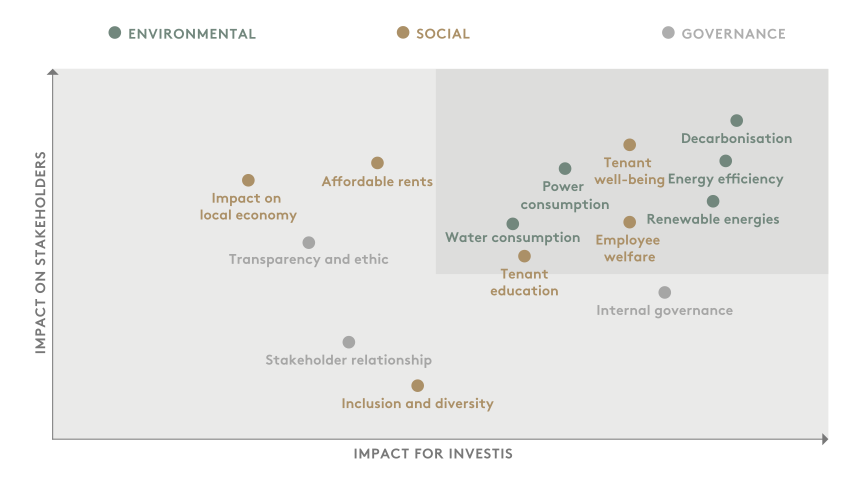
Double materiality matrix
Understanding and managing sustainability impacts has become crucial for Investis. The company has developed a comprehensive methodology to identify, assess and address its key sustainability challenges and opportunities.
Through a structured double materiality assessment, Investis identifies and prioritises sustainability issues that could materially affect decisions, actions and dimensions: the actual and potential economic, environmental and human impacts of Investis’s activities across the value chain and the sustainability issues that affect the company’s value creation. The focus is on reducing emissions and minimising environmental damage. The results of the assessment drive strategic planning, risk management and sustainability reporting while ensuring that Investis remains adaptable to emerging trends and regulatory and stakeholder expectations. This structured approach ensures that Investis’ sustainability strategy remains relevant and transparent by understanding both the organisation’s impact on sustainable development and how sustainability issues affect long-term value creation.
The process follows a systematic four-phase approach to determine its material topics:
- Initially, comprehensive desk research analysed industry trends, peer benchmarking and sustainability frameworks. This was complemented by a thorough review of internal strategy documents, risk assessments and previous materiality analyses, culminating in an initial list of potential material issues relevant to the real estate sector.
- The second phase focused on extensive stakeholder engagement through structured interviews, surveys and expert consultations. The company gathered valuable input from external experts, including sustainability consultants and industry specialists and actively engaged with key stakeholders such as investors, tenants and local communities. Throughout this phase, stakeholder concerns, expectations and priorities were meticulously documented.
- In the assessment phase, Investis evaluated each topic’s significance using a dual materiality approach. This involved assessing both impact materiality – examining the organisation’s actual and potential impact on the economy, environment and people – and financial materiality, analysing how the issues affect enterprise value. The findings were visualised in a materiality matrix, which plots the impact on people and the environment against the impact on Investis.
- The final validation and implementation phase involved senior management and the Board of Directors reviewing the material issues. The findings were integrated into strategic planning and target setting, leading to the development of specific action plans and KPIs for the most important topics. Investis established regular monitoring and reporting mechanisms to track progress and implemented an annual review cycle to ensure the continued relevance of the identified material issues.
Risk management
Environmental, Social and Governance (ESG) considerations are fully integrated into Investis’s risk management framework, demonstrating the Group’s commitment to sustainable business practices. Through systematic property impact assessments, detailed climate change vulnerability analyses and targeted energy efficiency initiatives, the Group has strengthened its approach to environmental risk management. This integration of ESG risks into the overall risk management process enables a more comprehensive understanding of both current and emerging challenges facing the real estate sector.
The Group’s risk management framework operates through clear lines of responsibility and standardised procedures, ensuring that sustainability and risk considerations are integrated into all decision-making processes. Regular monitoring and assessment procedures are in place to assess the effectiveness of the implemented measures. Investis regularly reviews its risk landscape, taking into account evolving regulatory requirements, market conditions and stakeholder expectations. This dynamic approach allows the Group to adapt its risk mitigation strategies and maintain resilience in a changing environment. Through active stakeholder engagement and continuous improvement of its risk management processes, Investis maintains its ability to effectively identify, assess and mitigate risks, while advancing its sustainability agenda across all operational aspects.
To provide transparency on the ESG risk management approach, Investis has developed a comprehensive matrix that aligns material issues with associated risks, mitigation measures and key performance indicators (KPIs). This structured overview enables stakeholders to understand how the Group addresses specific sustainability challenges and monitors progress. The following table presents the key material issues identified through the stakeholder engagement process, the corresponding risks they pose to the business, the actions taken to address these risks and the KPIs used to track the performance and effectiveness of the actions.
Material topics | Risk | Horizon of action | Measure | KPIs |
Decarbonisation & Renewable Energies | Temperature rise due to greenhouse gas | Short term | Change of heating systems | Use of renewable energy CO2 consumption |
Power Consumption & Water Consumption | Restricted availability of energy | Short term | Efficient household appliances | Electricity consumption |
Waste of water/energy | Long term | Water flow reducers in bathroom | Water consumption | |
Energy Efficiency | Reduced attractiveness/ rentability of unrenovated stock | Medium term (ongoing) | Measuring building efficiency | Average CECB grade |
Feasibility study of renovation using CECB+ | Number of CECB+ ordered in relation to the number of buildings | |||
Tenant Education | Over-consumption | Short term | Eco-housing action plan | |
Ecological action guide | ||||
Tenant Wellbeing | Climate change and overheating in homes | Medium term | Monitoring of the indoor temperature | Tenant satisfaction, measured by surveys |
Restrictions on usability, rentability, higher vacancy rate, increased building quality requirements | Housing renovation | |||
Employee Welfare | Limited progression and deteriorating working conditions | Medium term | Employee training and flexible working hours | Turnover |
Changing employee expectations | Safety improvements | Annual illness and accident rates |
Decarbonisation & Renewable Energies
Decarbonisation represents a critical challenge. The primary concern is the rising global temperature due to greenhouse gas emissions, which could affect tenants comfort or trigger stricter regulations and impact property values. The Group’s decarbonisation strategy focuses specifically on the transition away from fossil fuel dependency. Key measures include a systematic assessment of heating system replacements, with priority given to buildings with aging fossil fuel installations and the development of a clear roadmap for the integration of renewable energies. Technical feasibility studies are conducted on prioritised properties to determine the most appropriate renewable energy solutions, taking into account factors such as geothermal potential, solar capacity and district heating availability. Success is measured through targeted KPIs that track CO2 consumption levels, the percentage of renewable energy in the total energy mix and the number of heating systems successfully converted.
Power & Water Consumption
Managing energy and water resources presents unique operational challenges. The key risks are the limited availability of resources and the potential waste of water and energy, which could lead to supply shortages and increased utility costs. The Group focuses on optimising consumption patterns through targeted infrastructure improvements. Primary measures include the systematic installation of water flow reducers in taps and showers and the replacement of outdated appliances with energy-efficient alternatives. These measures are prioritised based on analysis of consumption data and equipment age. Performance is measured against specific KPIs such as total water consumption per square metre and electricity consumption in common areas. The effectiveness of these measures is regularly assessed through comparative analysis of consumption data, enabling rapid responses to any efficiency deviations and supporting the Group’s resource conservation objectives.
Energy Efficiency
Energy efficiency impacts manifest across the operational scope, encompassing both internal operations and value chain partnerships. Within its direct control, energy consumption is primarily related to building operations, including heating and electricity use in common areas. External impacts occur through relationships with energy service providers and contractors, extending Investis’s energy management approach beyond its direct control. Key risks include reduced property attractiveness and potential loss of rental income due to poor energy performance, as well as increasing regulatory compliance costs. To address these challenges, Investis implements a comprehensive set of measures such as measurement of building efficiency through energy monitoring systems and conducting feasibility studies for renovation projects. Performance is tracked against specific KPIs including the number of CECBs (Cantonal Energy Performance Certificates) ordered, energy consumption per square metre and the completion rate of planned energy efficiency improvements. Stakeholder engagement includes tenant awareness programmes about energy-saving practices, collaboration with energy suppliers for consumption monitoring and partnerships with technical experts for optimisation recommendations and energy audits. This structured approach ensures continuous improvement in building energy performance while maintaining property value and tenant satisfaction.